Pho: The Young Soup That Carries a Whole Country
Pho feels ancient, but it's barely over a century old — born in northern Vietnam around 1900, argued over by the French, split by war into two styles, and carried worldwide by refugees.
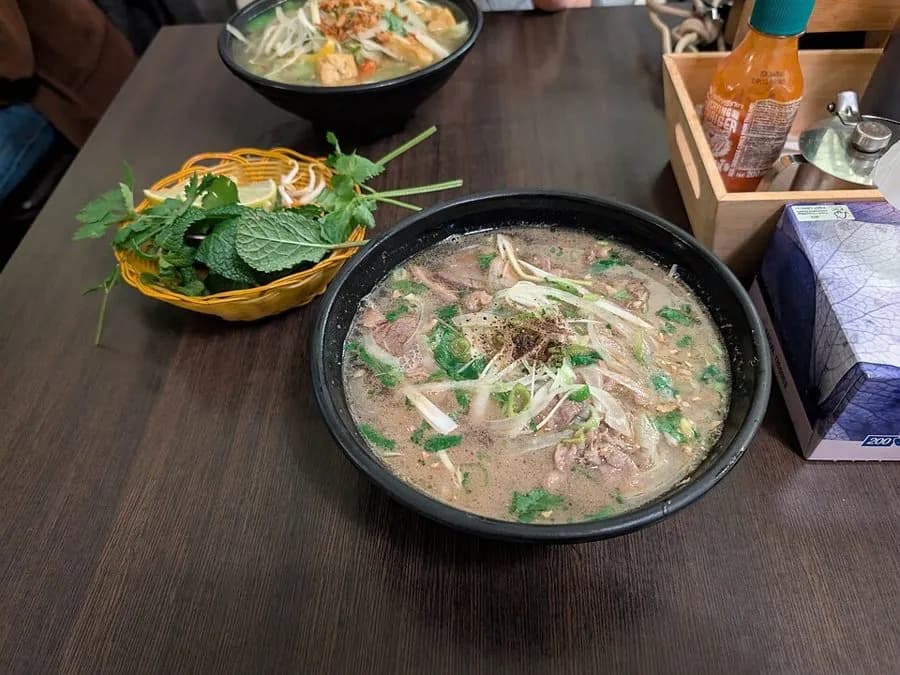
Some dishes feel so essential to a country that you assume they've been there forever. Pho — Vietnam's aromatic beef noodle soup — feels a thousand years old. It is, at best, about a hundred and twenty. That youth makes its story sharper: pho was born in a colonial collision, split in half by a war, and carried across oceans by people who had lost nearly everything else.
Born Around 1900, North of Hanoi
Food historians generally place pho's birth in the early 1900s in northern Vietnam, around Hanoi and Nam Dinh province. Two forces converged there. First, French colonizers created new demand for beef — cattle had mainly been work animals — leaving bones and scraps that Vietnamese cooks turned into broth. Second, existing Vietnamese and Chinese noodle-soup traditions supplied the technique and the rice noodles. Street vendors carrying shoulder poles sold the new soup to dawn workers, and by the 1920s and 30s pho shops were fixtures of Hanoi life — beloved enough that writers of the era, including the celebrated essayist Thach Lam, wrote about the soup with open devotion.
The Pot-au-Feu Question
Where does the name come from? One theory says 'pho' derives from 'feu' in pot-au-feu, the French boiled-beef dish, pointing to the charred onion and ginger in pho broth as a French-style touch. Another theory traces it to Chinese-derived words for rice noodles spoken by Yunnanese and Cantonese vendors. Scholars still disagree, and the honest answer is that pho was probably a genuine fusion: Vietnamese hands, Chinese noodles, French-era beef. The soup, diplomatically, refuses to settle the argument.
Pho is what happens when history throws three cuisines into one pot and lets it simmer.
North and South: Two Bowls, One Name
After Vietnam's 1954 partition, roughly a million northerners moved south, bringing pho with them. In Saigon the soup loosened up: sweeter broth, more herbs, bean sprouts, lime, and eventually hoisin and sriracha on the table. Northern pho stayed austere — clearer broth, wider noodles, green onion, and a firm belief that the broth needs no decoration. After 1975, refugees carried the southern style around the world, which is why the pho in most overseas restaurants comes with that glorious pile of herbs.
- Pho bac (northern) — minimalist, clear, purist's choice
- Pho nam (southern) — herbs, sprouts, sauces, maximalist joy
- Pho bo — beef, the original
- Pho ga — chicken, the gentle cousin
However you take your bowl, you can pretend-order pho on PhantomBite for exactly $0 and watch a ghost rider ferry it across the map with zero broth-spill risk — nothing spills when nothing exists. For the real thing, the dish page has a 20-minute recipe that gets you a fragrant, honest bowl without the twelve-hour bone simmer. History optional, star anise mandatory. 🍲
✍️ Written by the PhantomBite editorial team for the joy of it. Food history is often contested — where the record is murky, we say so rather than pretend to certainty. Recipes are tested to work in a home kitchen. The delivery, of course, is not.