How Korea Took the Corn Dog, Wrapped It in Potatoes, and Broke the Internet
The American state-fair corn dog crossed the Pacific and came back wearing potato cubes, a dusting of sugar, and a heart of molten mozzarella. Here's how that happened.
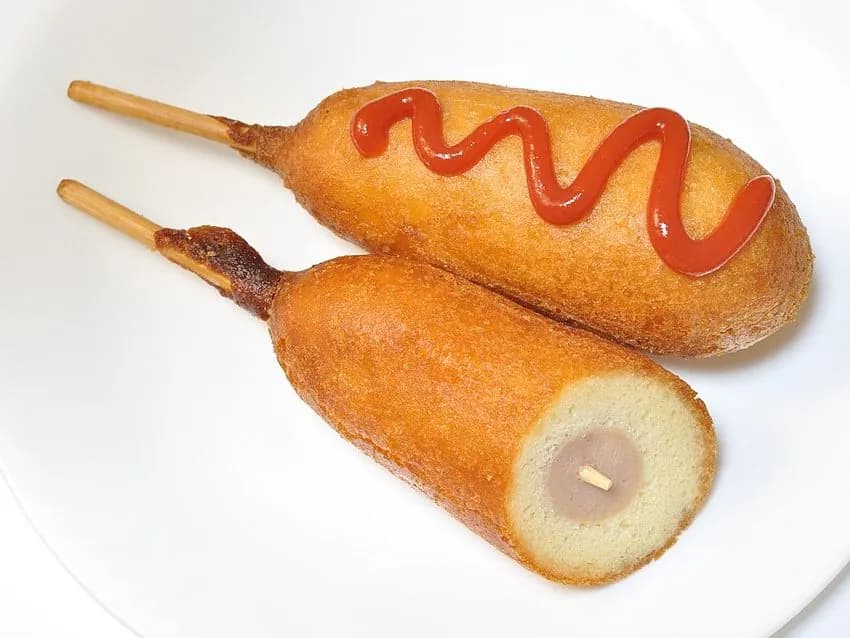
Somewhere between Texas and Myeongdong, the corn dog had a glow-up so dramatic its own inventors wouldn't recognize it. The original was a sausage dipped in cornmeal batter and deep-fried on a stick, a proud citizen of the American state fair. The Korean version kept the stick, kept the fryer, and replaced almost everything else with joy.
The State-Fair Original
The American corn dog's exact birthplace is contested — the story goes that vendors at the Texas State Fair popularized it in the 1940s as the Fletcher brothers' 'Corny Dog', while other stands across the Midwest claim earlier versions, and a 1920s patent for a machine that fried breaded foods on sticks muddies the timeline further. What everyone agrees on: cornmeal batter, hot dog, stick, mustard. It was cheap, portable, and perfectly engineered for eating while walking past a Ferris wheel. For roughly seventy years, that was the whole story, and nobody thought the formula needed touching.
Korea's Remix: The Gamja-Hotdog
Korea has had street hotdogs on sticks for decades — a familiar sight outside schools and subway stations since at least the 1980s — but the modern wave looks nothing like cornmeal. Korean vendors swapped the batter for a chewy, slightly sweet yeasted dough, closer to a doughnut than cornbread. Then came the signature move: rolling the whole thing in cubed potatoes or crispy ramen bits before frying, so it comes out looking like a delicious golden mace. And the mozzarella swap was the killer feature: replace the sausage, partly or entirely, with a stick of low-moisture mozzarella, and every bite becomes a cheese-pull photo op. Sweet, salty, crunchy, stretchy — it hits basically every button the human brain has.
- Gamja-hotdog: studded with crispy diced potato, the fan favorite
- Half-and-half: mozzarella on one end, sausage on the other
- The finishing touch: a shameless roll through granulated sugar before ketchup and mustard
The Myeongdong Wave
In the late 2010s, corn dog chains multiplied through Seoul's Myeongdong shopping district and beyond, and the cheese pull became one of the most exported food images on social media. Tourists queued for them between skincare shops; vloggers filmed the stretch in slow motion; the sugar-then-ketchup combination scandalized and then converted first-timers on camera. Korean corn dog franchises soon opened in Los Angeles, New York, London, and Bangkok, often with lines around the block in their first weeks. The corn dog had left America as a fairground snack and returned as K-street-food royalty. 🌭
It's not a corn dog. It's a doughnut that ate a cheese stick and dressed up as one.
Craving one right now? You can pretend-order a Korean corn dog on PhantomBite for exactly $0 — our ghost rider will heroically never deliver it — and then use the site's real 20-minute recipe to fry up the sugar-dusted, cheese-pulling real thing in your own kitchen.
✍️ Written by the PhantomBite editorial team for the joy of it. Food history is often contested — where the record is murky, we say so rather than pretend to certainty. Recipes are tested to work in a home kitchen. The delivery, of course, is not.