Carbonara: Four Ingredients, a Thousand Arguments
Nobody knows exactly who invented carbonara — American GIs, charcoal workers, or a clever Roman cook — but everybody in Italy knows one thing for certain: no cream.
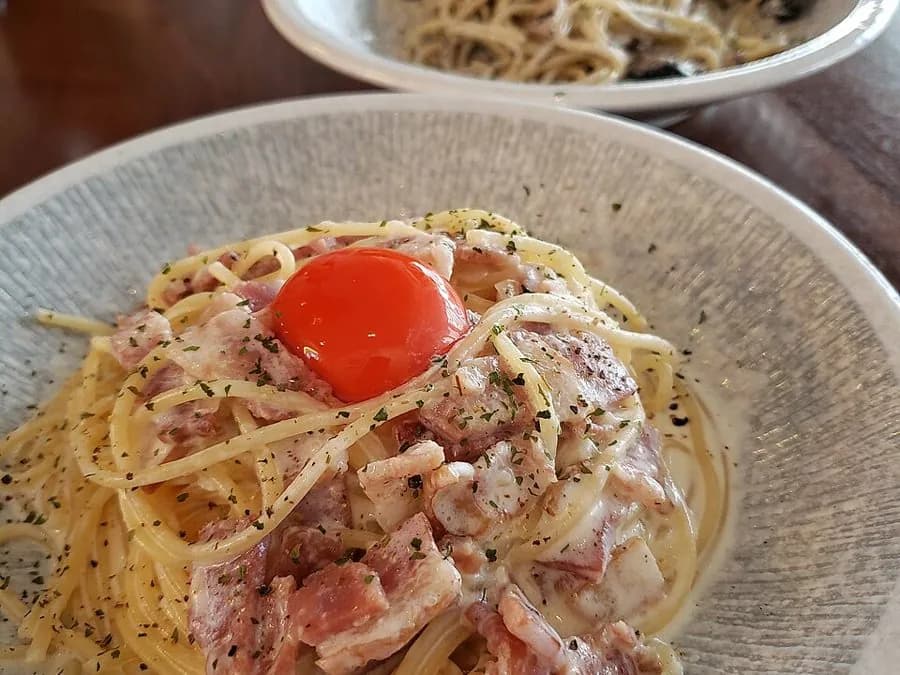
Carbonara looks simple: pasta, eggs, cured pork, pecorino, black pepper. Yet this five-minute-to-describe dish carries some of the fiercest debates in Italian food — starting with the awkward fact that nobody can prove where it came from, and it appears in no Roman cookbook before the 1950s. For a dish treated as ancient tradition, carbonara is suspiciously young.
Theory One: The American Connection
The most discussed origin theory points to Rome around 1944, just after the Allied liberation. American soldiers had rations full of eggs and bacon; Roman cooks had pasta and imagination. The story goes that some enterprising kitchen fused the two, creating a dish that suited both palates. Supporting evidence: the earliest known printed references to carbonara appear only in the early 1950s — one of the first, amusingly, in an American publication before the dish was codified in Italian cookbooks. Italian food historians like Luca Cesari have argued the dish's early recipes were wildly unstable, some even containing gruyère.
Theory Two: The Charcoal Workers
The name offers another clue — or another red herring. Carbonara evokes carbonai, the charcoal makers of the Apennine hills, who supposedly cooked hearty pasta with eggs and cured pork over their fires, the black pepper recalling flecks of charcoal. Others link the name to a Roman restaurant, or to the secretive 19th-century Carbonari society. Each theory has fans; none has proof. As the historians say, the story goes — and keeps going. What is certain is that by the 1960s the dish had settled in Rome's trattorias, and by the internet age every deviation from the canon could trigger a minor diplomatic incident.
Carbonara has no birth certificate, only a very strict code of conduct.
The Rules Italy Actually Enforces
Whatever its origins, modern Roman carbonara has hardened into doctrine. The sauce is an emulsion of raw egg (many insist on yolks), grated pecorino romano, and rendered pork fat, cooked gently by the pasta's own heat — never scrambled, never helped along by cream. Cream is the cardinal sin; garlic, onions, and peas are misdemeanors. The pork question is subtler: guanciale, cured pork jowl, is the orthodox choice, prized for its silky fat and deeper flavor, while pancetta, cured pork belly, is the tolerated substitute abroad. Bacon is discussed only in whispers.
- Guanciale — pork jowl, the orthodox choice, melts into silk
- Pancetta — pork belly, acceptable understudy
- Cream — absolutely not, do not even ask
- Pecorino romano and black pepper — non-negotiable
The beautiful irony: a dish possibly born from wartime improvisation is now guarded like a relic. If tonight feels like a carbonara night, pretend-order it on PhantomBite — $0, ghost rider dispatched, delivery permanently pending. Then make the real thing with the 20-minute recipe on the dish page. Just remember: the phantom forgives everything except cream. 🥓
✍️ Written by the PhantomBite editorial team for the joy of it. Food history is often contested — where the record is murky, we say so rather than pretend to certainty. Recipes are tested to work in a home kitchen. The delivery, of course, is not.